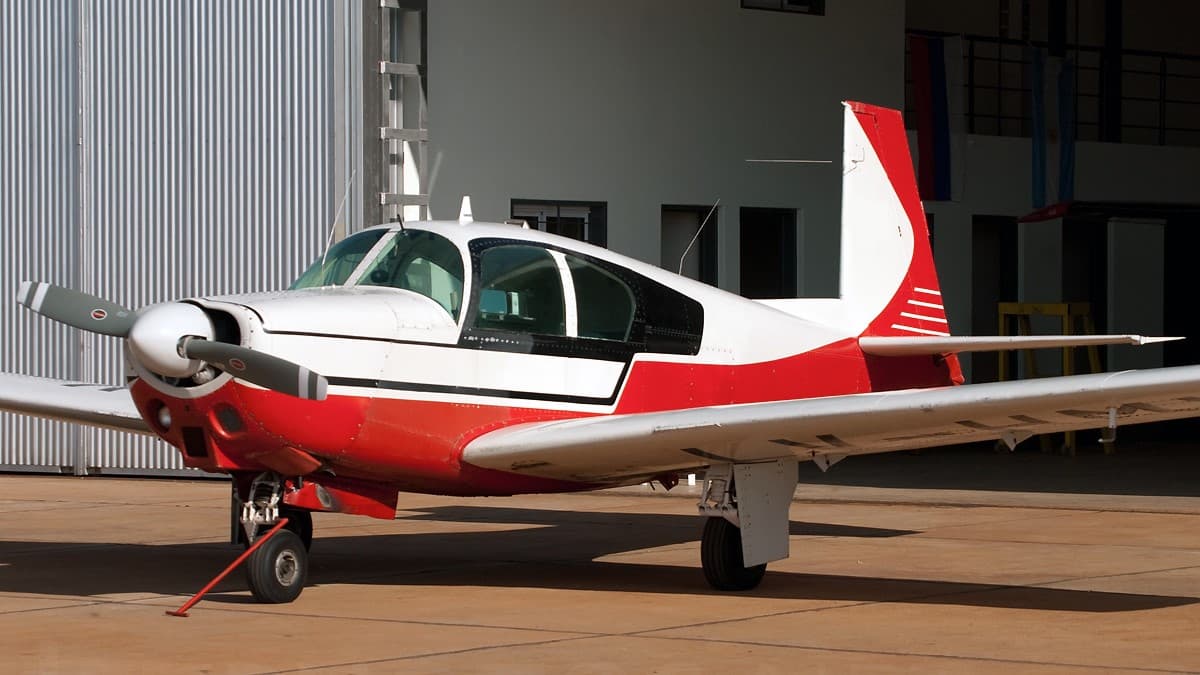
M20A
Piston
Einzigartig im Design.
Herausragend in
Leistung.
Mooneys derive their performance from a clean airframe with drag reduced by refinements over the years. Many of these refinements are Supplemental Type Certificate (STC) modifications to the airframe developed by after-market businesses. Some of these modifications have been incorporated into the factory production models.
The Mooney M20 series has been produced in three fuselage lengths: the "short-body" through M20E, "medium-body" (M20F through M20K), and "long-body" types. Although all M20s have four seats, the fuselage length increase provided more rear passenger legroom, but with a slight performance decrease. Other airplane improvements over the years in most cases more than compensated for the effects of a longer fuselage; for a similar engine and vintage, for instance, the shorter-fuselage model is faster, e.g., M20E vs M20F.
In July 2008, Mooney signed a memorandum of understanding with Rolls-Royce to develop a version of the M20 that was to have been powered by the Rolls-Royce RR500 TP turboprop powerplant. The project was announced as being a joint "marketing investigation" and "exploration project", but does not appear to have come to fruition.
Design
With the exception of the wooden wings and tails of the original M20 and M20A, M20s are all-metal, low-wing aircraft. The wings are of cantilever construction, consisting of a main spar and an auxiliary spar that extends from the fuselage to the middle position of the flaps. The wing skin is aluminum which is flush-riveted in many areas to reduce parasitic drag. Slotted flaps cover 70% of the trailing edge. The earliest models (prior to 1963) have manual flaps. Later models use a hydraulic hand pump to control the flaps while even-later models have electrically operated flaps. The forward fuselage has a steel tube cabin structure covered in aluminum skin, while the aft fuselage is of semi-monocoque design.
The tricycle landing gear legs of the Mooney M20 models are made of heat-treated chrome-molybdenum steel. The main gear legs are attached to the main wing spar, while the nose gear is mounted onto the steel cabin frame. Rubber discs, as well as spring steel, around the legs allow for compression and shock absorption on landing. Except for the fixed-gear M20D, the nosewheel retracts rearwards and the main wheels retract towards the fuselage. Early models use a hand-operated lever system to raise and lower the gear. Later models use an electrically operated landing gear retraction system with a backup crank-operated or wire-pull gear extender.
The Mooney M20 has medium aspect-ratio tapered wings, incorporating 1.5° of washout and 5.5° of dihedral. On the M20J, navigation and anticollision lights are located inside an aerodynamically designed cover at the wingtips to further eliminate drag. Later M20s are equipped with stall strips to improve the stall characteristics.
The empennage of the Mooney M20 is easily recognizable by its unique tail fin with a vertical leading edge. (The tail fin looks as though it is "leaning forward", but it is approximately vertical in level flight, depending on trim setting.) The horizontal tailplane, which consists of fixed stabilizers and trailing elevators, has no trim tabs. The entire tail assembly pivots at the rear of the fuselage to provide pitch trim.
All M20s store fuel in two separate "wet wing" tanks, which are located in the inboard sections of each wing. Fuel is driven from the tank to the injectors or carburetor by an engine-driven pump, backed up with an electric boost pump.[10]Deterioration of the wing tank sealant can be a problem, leading to expensive rework of the tanks. A modification is available to install rubber bladders inside the existing tanks.
For increased power many M20s also have a ram-air induction system, called the Mooney "Power Boost". For normal operations, the intake air is filtered before it enters the induction system. When ram air is selected, partially unfiltered air will enter the induction system with a higher pressure and consequently the manifold pressure will increase about a full pound per square inch when flying at 7500 feet above mean sea level, giving a greater power output. The turbocharged variants omit this feature, as the turbocharger provides a far greater increase in manifold pressure.
Variants
- M20 and M20A
- The original M20 (1955–1958) and the M20A (1958–1960) have wings made of wood covered with cloth, but are otherwise similar to later all-metal models. With the M20A, the power was increased from the M20's 150 hp (110 kW)Lycoming O-320 to the 180 hp (130 kW) Lycoming O-360-A1A or A1D.
- Early in the model's history, several incidents of wooden tails breaking up in flight occurred due to water damage and the resulting rot. Consequently, most tails have now been replaced with all-metal copies, as required by Mooney Service Bulletin M20-170A and the FAA Airworthiness Directive 86-19-10. Without the possibility of metal fatigue, the wooden wing has an indefinite life expectancy and is considered by some pilots to provide a smoother ride in turbulence.
Spezifikationen
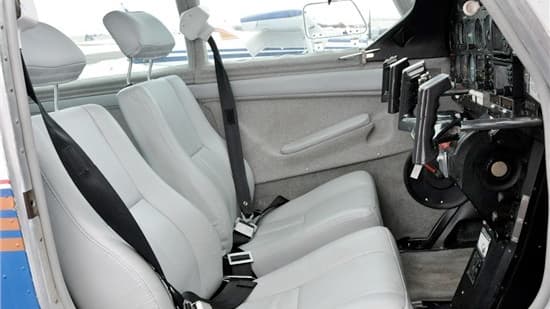
Kabinenabmessungen & Konfigurationen
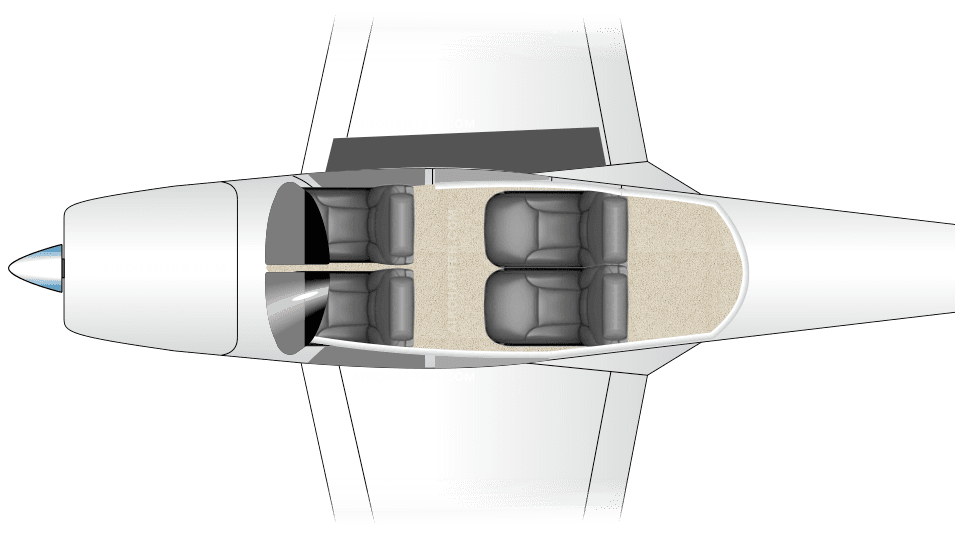
10.5
Länge
3' 6
Breite
3' 75
Höhe
Kabinenausstattung
- Golftaschen (1)
- Skitaschen (2)
Die M20A entdecken
Verpflichtet dem Flug
Der zu Ihnen passt
Unser beratender Ansatz führt Sie zu dem Privatjet-Charter, der Ihren Anforderungen am besten entspricht. Diese adaptive Philosophie ist ein Grundpfeiler dafür, wie wir unvergessliche Reisen ganz nach Ihren Wünschen und Vorlieben gestalten.
Verbinden Sie sich mit echter Luftfahrt-Expertise
M20A
$648/Std.