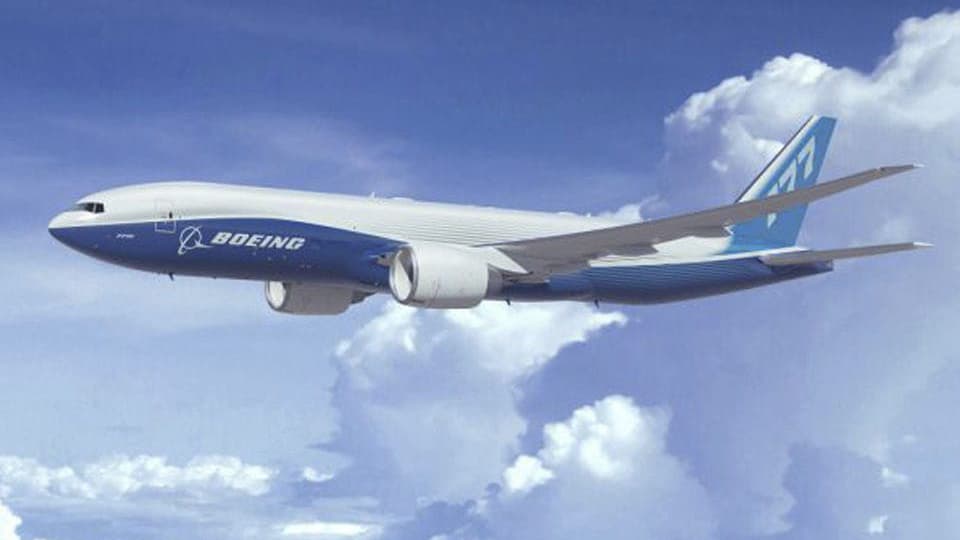
777 Freighter
Airliner
Distinto en Diseño.
Prodigioso en
Rendimiento.
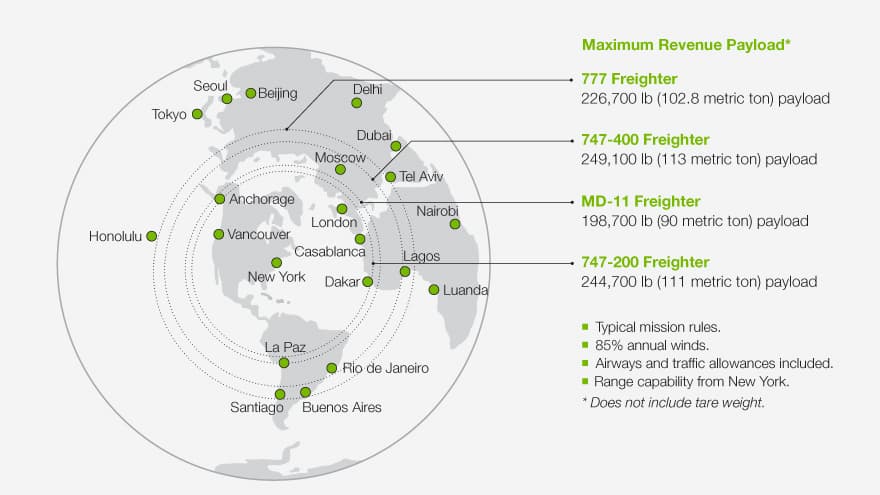
The range capability of the 777F provides significant savings for cargo operators. It enables them to take advantage of fewer stops and associated landing fees, less congestion at transfer hubs, lower cargo handling costs, and shorter cargo delivery times. The new freighter also integrates smoothly with existing cargo operations and facilitates interlining with 747 freighter fleets.
This article provides an overview of the 777F, including its heritage, freighter capabilities, range and capacity, twin-engine design, and ability to fit into existing cargo operations.
Launched in May 2005, the 777F inherits the same basic design and flight characteristics of 777 passenger airplanes but is designed specifically to transport cargo. It also shares many of the 777 family’s advanced features, such as a fly-by-wire design, an advanced wing design with raked wing tips, and a state-of-the-art flight deck. It is powered by the world’s most powerful commercial jet engine, the General Electric GE90-110B1.
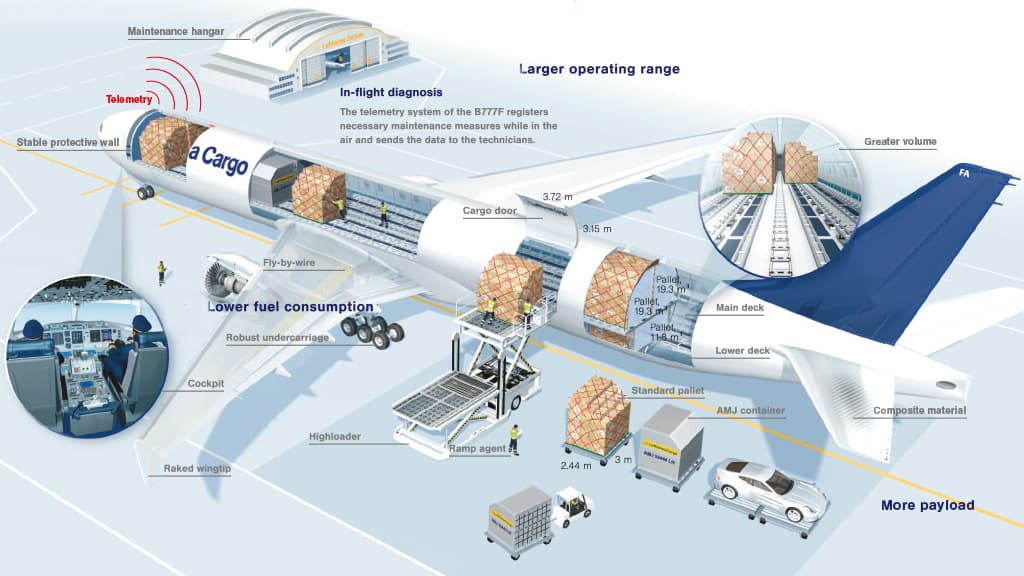
The 777F has been specifically designed as a freighter, with additional strengthening in key structural areas, including:
- New monolithic aluminum floor beams.
- Rigid cargo barrier located in the forward section of the airplane.
- Strengthened fuselage, especially in the area of the main deck cargo door.
Other design enhancements include:
- Enhanced, lightweight cargo-handling system with built-in test equipment that continually monitors the operational health of the system.
- Modified environmental control system.
- An advanced maneuver load alleviation system that redistributes the aerodynamic load on the wing during non-normal flight conditions, reducing the load on its outboard portion. This allows the 777F to operate in a wide variety of flight environments without compromising payload capability.
The 777F also features a new supernumerary area, which includes business-class seats forward of the rigid cargo barrier, full main deck access, bunks, and a galley.
The airplane’s design reflects information and feedback that Boeing gained at freighter working group meetings held with 20 airlines and cargo operators. Boeing’s plan was to ensure that the 777F would operate with procedures and handling similar to other 777 variants. The result is a common type rating with 777 passenger airplanes and only minimal transition required and lower training costs.
Especificaciones
Dimensiones y Configuraciones de la Cabina
73' 9
Longitud
19' 3
Ancho
60' 8
Altura
Comodidades de la Cabina
- Galley Full
- Lavatorio Full
Explore el 777 Freighter
Comprometidos con el vuelo
Que se Adapta a Usted
Nuestro enfoque consultivo para orientar un chárter de jet privado que mejor se ajuste a sus necesidades. Esta filosofía adaptativa es un elemento fundamental en cómo diseñamos viajes inolvidables en torno a sus términos y preferencias.
Conecte con Verdadera Experiencia en Aviación
777 Freighter
$26000 - $58500/h