Bombardier Challenger 350: Specs, Price & Charter Guide (2026)
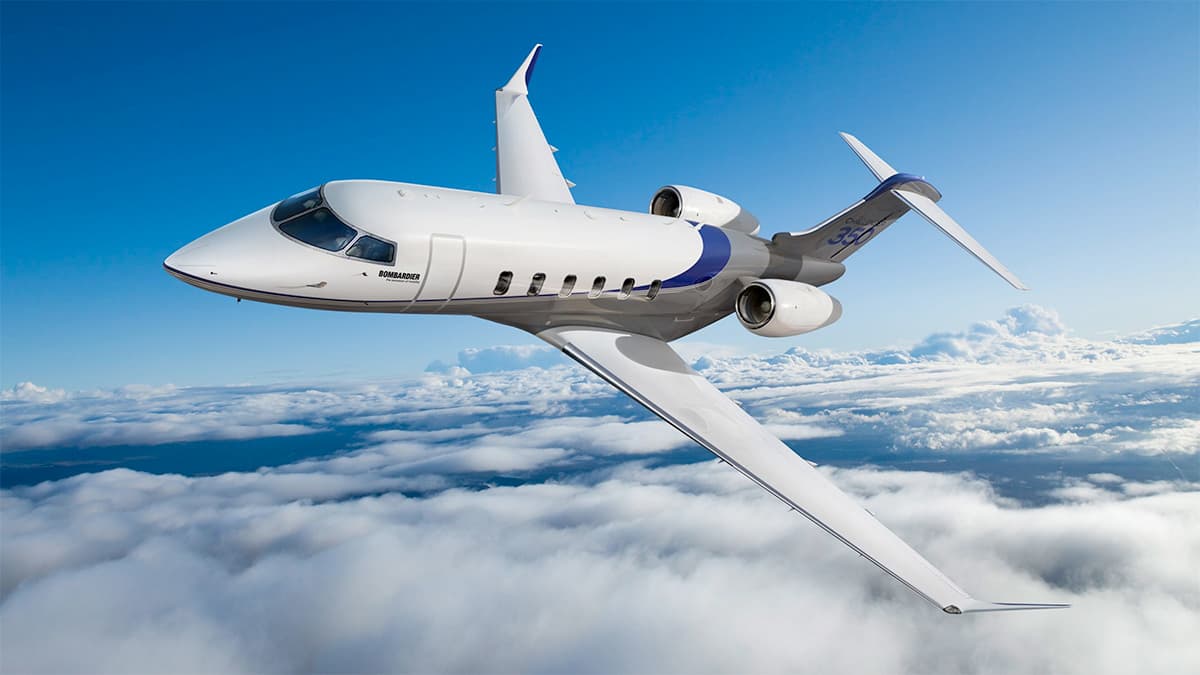
The Bombardier Challenger 350 is the best-selling super-midsize business jet in history — a 3,200 nautical mile, Mach 0.83, flat-floor-cabin workhorse that defined the category from its 2014 entry into service until Bombardier rebranded the type as the Challenger 3500 in 2022. More than 450 Challenger 350s were delivered, and the type remains the most-chartered super-midsize jet in the world. This guide covers every Challenger 350 spec that matters, real 2026 charter hourly rates from the DesJets operator network, a full cabin tour, and how it compares to the Cessna Citation Longitude, Embraer Praetor 600, and Gulfstream G280.
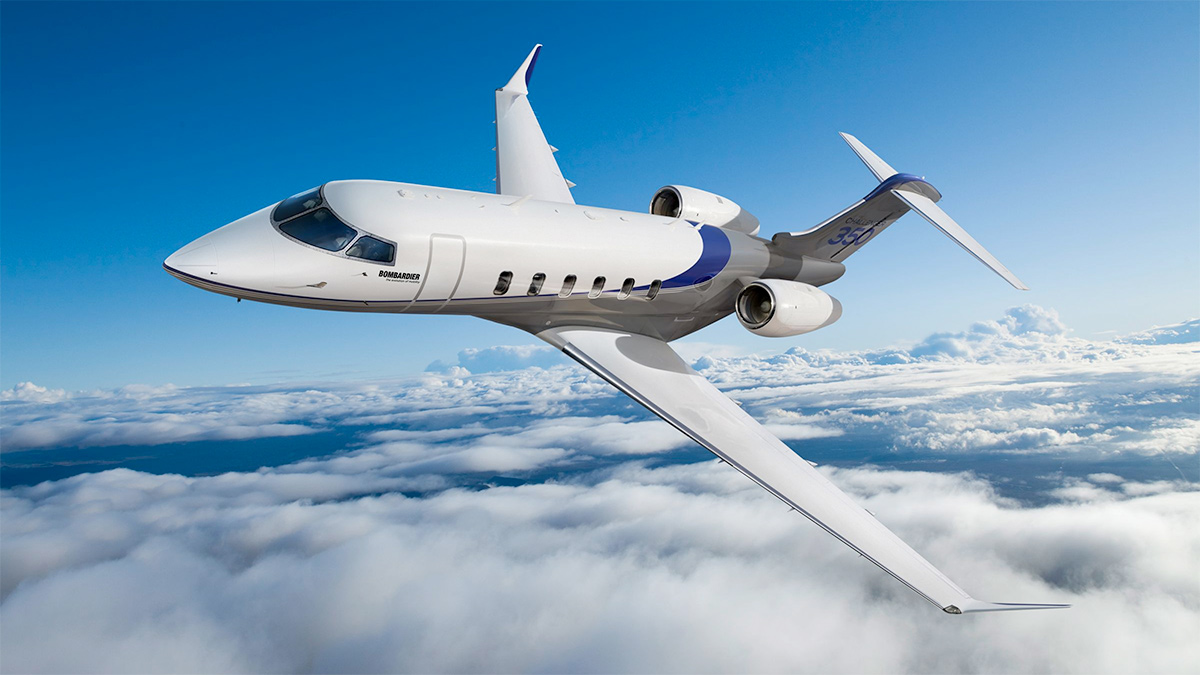
Bombardier Challenger 350 at a Glance
The Challenger 350 is a twin-engine super-midsize business jet built by Bombardier Aviation, derived from the earlier Challenger 300 (certified in 2003). The 350 program was announced at EBACE in May 2013 as a mid-life evolution: new Honeywell HTF7350 engines with 7,323 lbf of thrust each, canted winglets, a fully redesigned cabin, and improved avionics. First delivery was June 2014. In September 2021 Bombardier announced the follow-on Challenger 3500, which replaced the 350 on the production line in 2022 while keeping the same airframe and systems.
| Specification | Bombardier Challenger 350 |
|---|---|
| Manufacturer | Bombardier Aviation |
| Category | Super-midsize jet |
| Production | 2014 – 2022 (replaced by Challenger 3500) |
| Units delivered | 450+ (Challenger 350 variant) |
| Max range | 3,200 nm (5,926 km) with 8 pax, NBAA IFR reserves |
| Max cruise speed | Mach 0.83 (~470 KTAS) |
| Long-range cruise | Mach 0.80 |
| Max operating altitude | 45,000 ft |
| Engines | 2 × Honeywell HTF7350 (7,323 lbf thrust each) |
| Passenger seats | Up to 10 (typical: 8–9) |
| Crew | 2 pilots (cabin crew optional) |
| Cabin length | 25 ft 2 in (7.67 m) |
| Cabin width | 7 ft 2 in (2.19 m) |
| Cabin height | 6 ft 0 in (1.83 m) — flat floor |
| Baggage capacity | 106 cu ft (in-flight accessible) |
| Takeoff distance | 4,835 ft (sea level, MTOW) |
| Landing distance | 2,364 ft |
| Charter rate (2026) | $5,200 – $14,004 per hour |
| New list price (at end of production) | ~$27 million |
Range, speed, ceiling, and cabin dimensions above are Bombardier's published Challenger 350 specifications. Charter rate range is the actual quoted band across the DesJets Challenger 350 operator network.
Challenger 350 Range: True Transcontinental Non-Stop
The Challenger 350's certified maximum range is 3,200 nautical miles (5,926 km) with 8 passengers and NBAA IFR reserves, at long-range cruise of Mach 0.80. That is enough to connect any US coast-to-coast city pair non-stop in both directions year-round, including the harder westbound legs that fight the jet stream. It is the range that made the super-midsize class a genuine substitute for a heavy jet on most domestic missions.
Representative Challenger 350 missions flown routinely:
- New York (TEB) → Los Angeles (VNY) — 2,145 nm, non-stop westbound into the jet stream
- Los Angeles (VNY) → New York (TEB) — 2,145 nm, non-stop with ~1 hour of reserve
- Miami (OPF) → Seattle (BFI) — 2,440 nm, non-stop
- Chicago (MDW) → London (LTN) — 3,420 nm, typically one-tech-stop or weight-restricted
- Honolulu (HNL) → San Francisco (SFO) — 2,080 nm, non-stop
- London (LTN) → Dubai (DWC) — 2,970 nm, non-stop
- São Paulo (GRU) → Miami (OPF) — 3,540 nm, typically one-tech-stop
The practical ceiling for a non-stop Challenger 350 mission is about 2,900 nm in real-world operations with full passengers, catering, and typical reserves. Routes beyond that trigger either weight restrictions on passengers and baggage or a fuel stop. For most North American and intra-European missions, that envelope is more than enough.
Challenger 350 Speed: Mach 0.83 Super-Midsize Cruise
The Challenger 350's maximum operating speed is Mach 0.83 (approximately 470 knots true airspeed at altitude). Long-range cruise is Mach 0.80. That makes it one of the faster super-midsize jets in service — not the absolute fastest (the Citation Longitude and Praetor 600 both reach Mach 0.83–0.86 at high-speed cruise), but consistent and efficient at Mach 0.80 LRC where most of its mission time is spent.
Typical block times:
- New York to Los Angeles in about 5h 15m westbound, 4h 30m eastbound
- Miami to Aspen in about 3h 45m
- London to Moscow in about 3h 30m
- Dubai to Mumbai in about 2h 45m
The 45,000 ft service ceiling is the same as most heavy jets and well above commercial airline traffic, which translates in practice to fewer deviations around weather and smoother rides on turbulent legs — especially over the Rockies and the North Atlantic.
Challenger 350 Interior: Flat-Floor Super-Midsize Cabin
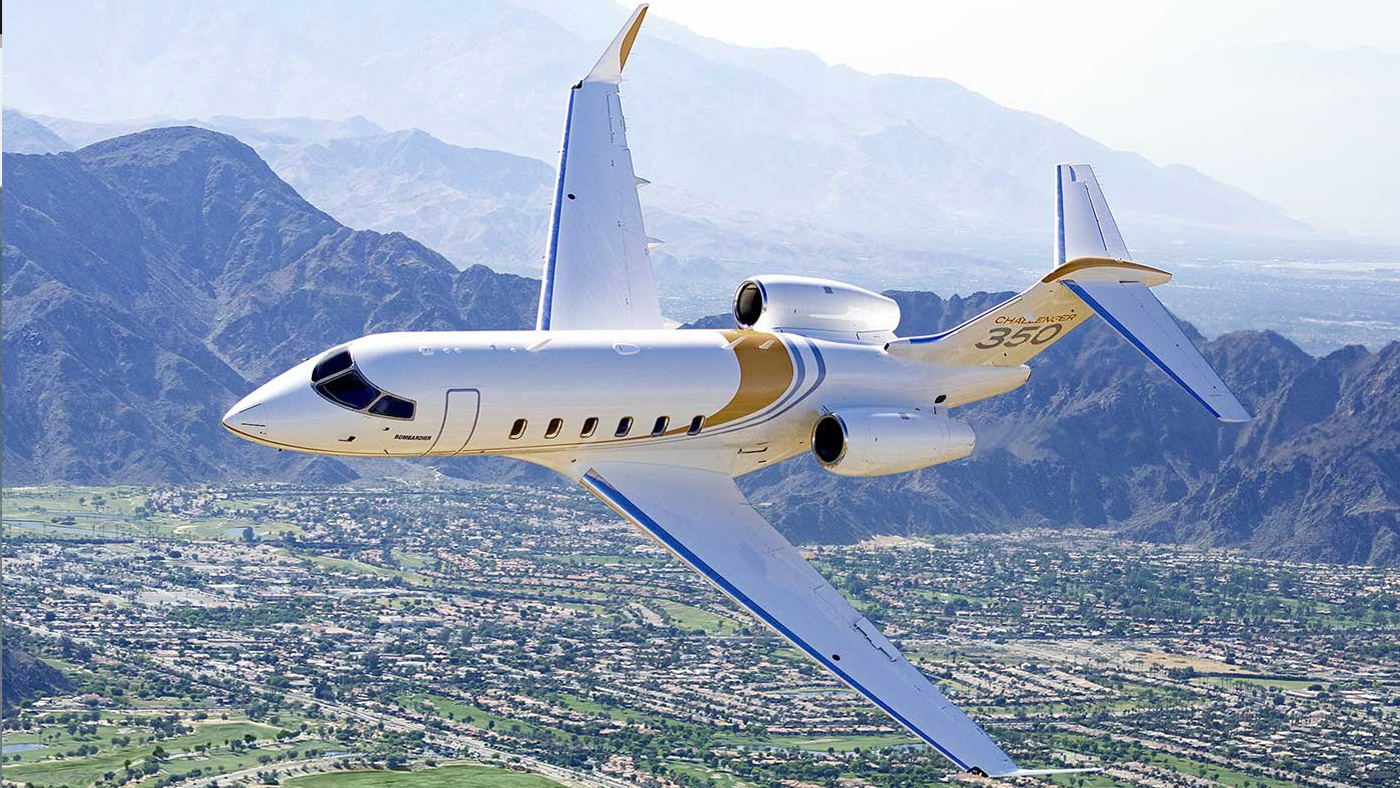
The Challenger 350 cabin is 25 ft 2 in long, 7 ft 2 in wide, and 6 ft 0 in tall — a true flat-floor cabin, with no center aisle "step" between the passenger area and the baggage compartment. The 7 ft 2 in cabin width is the widest in the super-midsize class, matching the Gulfstream G280 and exceeding the Citation Longitude (6 ft 5 in) by nine inches at the shoulders. The flat floor matters more than the dimensions suggest: it means you can walk the length of the cabin without stepping over a rail, and the center aisle usable for a full stretch is noticeably longer than on a cabin with a hump.
Standard Double-Club Layout
The most common Challenger 350 configuration is a double-club: four club seats facing forward and aft with a worktable between each pair, delivering sleeping space for four when the seats are berthed into facing beds. A three-place divan replaces the aft club pair in some configurations, bringing passenger capacity to nine and sleeping to five.
Seats and Finishes
Challenger 350 seats recline, swivel 180°, and track outboard — important detail: the seats widen the aisle when stowed. All leathers and veneers are configurable at delivery; the standard interior palette Bombardier offered at launch is a cream-and-stone combination that most charter 350s retain. Each seat has independent side-table controls, 110V AC and USB-A/C power, and a dedicated reading light.
Galley and Lavatory
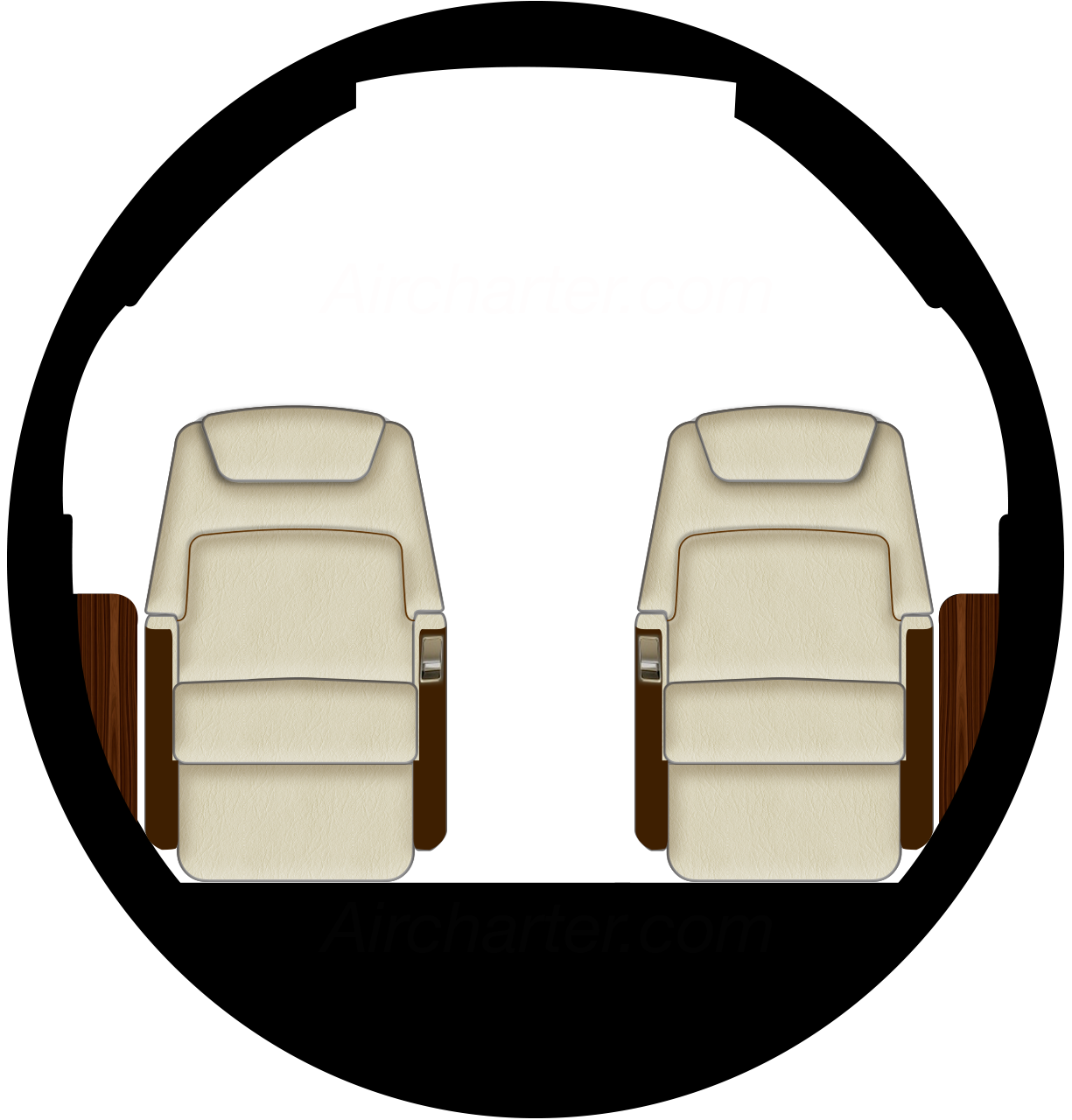
The forward galley carries a high-temperature oven, espresso machine, cold-storage drawers, and a crew jump seat. The aft lavatory is externally serviced and includes a vanity sink, large mirror, and direct access to the 106 cu ft baggage compartment — so passengers can retrieve carry-on items in flight without the crew needing to open an external door.
Cabin Systems and Amenities
- Cabin altitude: 4,850 ft when the aircraft is at 45,000 ft — low for the super-midsize class, meaning less arrival fatigue on 4+ hour legs
- Windows: 15 large windows per side, among the largest in the super-midsize category
- Cabin management: Bombardier's cabin control system, operated via dedicated panels and (in later deliveries) via personal device apps
- Connectivity: Ka-band or Ku-band satellite Wi-Fi, retrofitted on most 2016+ aircraft; the standard is Gogo Avance L5 on US-based 350s and Ka-band on international aircraft
- Noise: 52 dB at cruise — one of the quietest super-midsize cabins when the engines are properly rigged
- In-flight baggage access: full 106 cu ft compartment accessible through the aft lavatory, unusual outside heavy jets
Challenger 350 Charter Cost: 2026 Hourly Rates
Challenger 350 charter rates in 2026 run $5,200 to $14,004 per flight hour across the DesJets operator network, with most quotes landing in the $7,500–$9,500 band. The spread reflects positioning cost, aircraft year of manufacture, cabin configuration, and interior condition — older 2014–2016 350s with factory interiors sit toward the lower end, while 2020+ aircraft with refurbished cabins and newer avionics (Gogo 5G, upgraded Nice touchscreens) sit at the top of the range.
| Route | Distance | Flight time | Typical charter cost (2026) |
|---|---|---|---|
| New York (TEB) → Los Angeles (VNY) | 2,145 nm | ~5h 15m | $42,000 – $62,000 |
| Miami (OPF) → New York (TEB) | 950 nm | ~2h 30m | $20,000 – $28,000 |
| Chicago (MDW) → Aspen (ASE) | 840 nm | ~2h 15m | $18,000 – $26,000 |
| Dallas (ADS) → Las Vegas (VGT) | 960 nm | ~2h 30m | $20,000 – $28,000 |
| London (LTN) → Dubai (DWC) | 2,970 nm | ~6h 30m | $50,000 – $70,000 |
| Zurich (ZRH) → Moscow (VKO) | 1,250 nm | ~3h 00m | $22,000 – $30,000 |
What's Included in a Challenger 350 Charter Quote
A typical Challenger 350 quote includes aircraft time, 2 pilots (and a cabin attendant if requested), standard catering, standard ground handling, and standard fuel. Variables added on top:
- Federal Excise Tax: 7.5% on US domestic segments (statutory); international segments are exempt
- Fuel surcharge: 5–15% of base rate, resets monthly; the Challenger 350 burns ~245 US gal/hr, so fuel is meaningful on multi-hour legs
- International handling and permits: $1,500 – $6,000 depending on jurisdictions crossed
- Overflight and landing fees: typically $500 – $4,000 on international routes
- Catering upgrades: $400 – $2,000 per leg for custom VIP menus
- Positioning: charged if the aircraft has to fly empty to reach you — common on CL350 because the fleet is dispersed; building the quote around a nearby base can cut 20–30%
Empty leg opportunities on the Challenger 350 are among the most common in business aviation — the type's deep installed base (450+ delivered, hundreds in active Part 135 service) means there are usually several repositioning flights in play on any given day. DesJets publishes current CL350 empty legs in the empty leg listings, often at 40–60% off standard charter pricing.
Challenger 350 Purchase Price: New and Used
Bombardier's final list price on the Challenger 350 was approximately $27 million at the end of the production run in 2022, up from the $25.4 million launch price in 2014. The type was replaced by the Challenger 3500 on the production line, which keeps the same airframe and systems but adds a redesigned cabin, voice-controlled cabin management, 24-inch 4K monitors, and ergonomic seat upgrades.
Used Challenger 350 market pricing (2026 typical):
- 2014 early production (first-year aircraft): $11M – $14M
- 2016–2018 delivery (mid-life): $14M – $18M
- 2019–2020 delivery: $18M – $22M
- 2021–2022 (final production, low-time): $22M – $26M
Residual values on the Challenger 350 have held unusually well for a type that was superseded on the production line — a function of its deep operator community, strong parts and MRO support, and the fact that most buyers consider the 3500 an interior upgrade rather than a different aircraft. Preowned Challenger 350 availability typically runs 3–5% of the installed fleet, which is tight for business aviation.
Total Cost of Ownership
Direct operating cost on the Challenger 350 runs approximately $2,500–$3,200 per flight hour (fuel at current prices, engine reserves on the Honeywell MSP Gold program, airframe maintenance reserves), before fixed costs. Adding pilots, insurance, hangar, and non-flying overhead, budget approximately $1.8–2.5 million per year at 400 annual flight hours — a typical owner-operated utilization. This is the underlying operating cost that operators mark up to produce the $5,200–$14,004 charter rate you see in the market.
Challenger 350 vs the Competition
| Aircraft | Max Range | Max Speed | Cabin (L × W × H) | Charter $/hr |
|---|---|---|---|---|
| Bombardier Challenger 350 | 3,200 nm | Mach 0.83 | 25'2" × 7'2" × 6'0" | $5,200 – $14,004 |
| Bombardier Challenger 3500 | 3,400 nm | Mach 0.83 | 25'2" × 7'2" × 6'0" | $6,000 – $15,000 |
| Cessna Citation Longitude | 3,500 nm | Mach 0.86 | 25'2" × 6'5" × 6'0" | $5,500 – $12,000 |
| Embraer Praetor 600 | 4,018 nm | Mach 0.83 | 27'3" × 6'10" × 6'0" | $6,000 – $13,500 |
| Gulfstream G280 | 3,600 nm | Mach 0.84 | 25'10" × 7'2" × 6'3" | $6,500 – $14,500 |
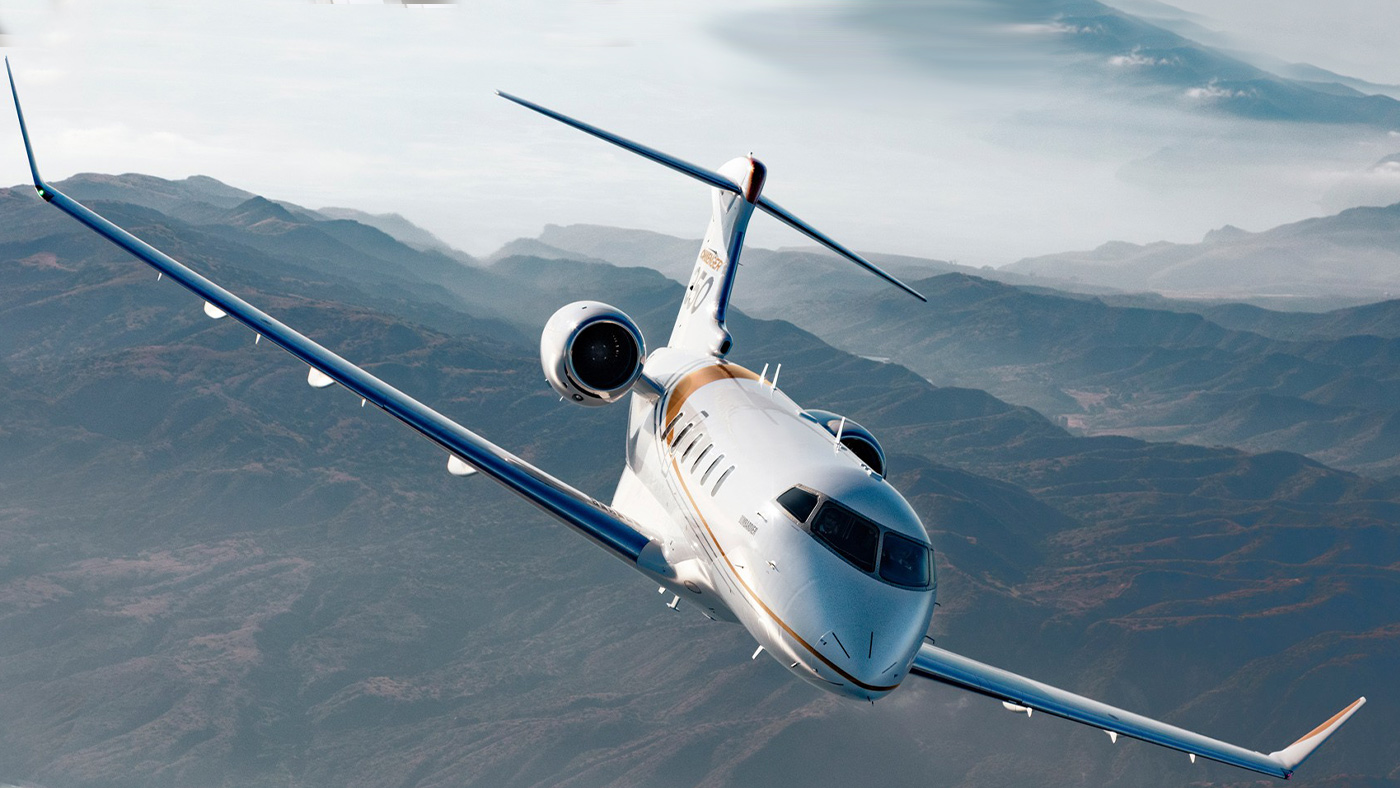
Where the Challenger 350 wins: the deepest installed base in super-midsize (450+ delivered), which translates to the widest charter availability, the most parts and MRO coverage, and the easiest empty-leg sourcing of any aircraft in the class; the widest flat-floor cabin at 7 ft 2 in, matched only by the G280; and the best-rated takeoff and landing performance (4,835 ft and 2,364 ft) at full gross weight, meaning Aspen, Telluride, and St. Barts are all in the operating envelope.
Where competitors win: the Praetor 600 beats the 350 on range (4,018 vs 3,200 nm), making it a genuine non-stop US transcon-plus-Caribbean machine; the Citation Longitude is marginally faster at high-speed cruise (Mach 0.86 vs 0.83); the Gulfstream G280 adds three inches of cabin height and marginally better range (3,600 nm). The successor Challenger 3500 is essentially the same aircraft with a refreshed interior and slightly extended range — meaningful mostly on aesthetics, not capability.
Charter, Fractional, Card, or Own: How to Decide
How much you fly determines which access model fits the Challenger 350. The 350 is one of the most common fractional and jet-card aircraft in service — NetJets, Flexjet, and VistaJet all operate large Challenger 350 and 3500 fleets, which keeps availability high across all access models.
- Under 50 hours/year — on-demand charter is the only rational answer. No commitment, no exposure to residual risk, and the 350's deep fleet means you can usually find an aircraft within positioning distance.
- 50–200 hours/year — jet cards (NetJets Marquis, Flexjet 25, VistaJet Program) make sense for schedule certainty and fixed-rate hourly billing, especially if your mission profile is unpredictable.
- 200–350 hours/year — fractional ownership (NetJets or Flexjet) becomes competitive. The economics turn on utilization: 1/16 shares make sense near 50 hours, 1/8 shares near 100 hours, 1/4 shares near 200 hours.
- 350+ hours/year — full ownership becomes viable, especially when paired with a Part 135 charter management arrangement that offsets fixed cost when the aircraft is not flying for the owner.
For most Challenger 350 mission profiles — US coast-to-coast transcon, international one-stop, 6–8 passengers once or twice a month — the honest answer is that charter or a 1/16 fractional share delivers a near-identical experience to ownership at a small fraction of the annual cost. Full ownership only pays back at genuine high utilization or when privacy and schedule control dominate the economic math.
Frequently Asked Questions
What is the range of the Bombardier Challenger 350?
The Challenger 350's certified maximum range is 3,200 nautical miles (5,926 km) with 8 passengers and NBAA IFR reserves, at long-range cruise of Mach 0.80. That is enough to fly any US coast-to-coast city pair non-stop in both directions year-round, including the harder westbound legs against the jet stream, and to connect London to Dubai or Honolulu to San Francisco non-stop. Practical real-world range at full load is approximately 2,900 nm.
How fast does the Challenger 350 fly?
The Challenger 350 has a maximum operating speed of Mach 0.83 (approximately 470 knots true airspeed) and a long-range cruise of Mach 0.80. Typical block times: New York to Los Angeles in about 5h 15m westbound and 4h 30m eastbound, Miami to Aspen in about 3h 45m, London to Moscow in about 3h 30m. Service ceiling is 45,000 ft, equivalent to most heavy jets and above commercial traffic.
How much does it cost to charter a Challenger 350?
Challenger 350 charter rates run $5,200 to $14,004 per flight hour in 2026, with most quotes landing in the $7,500–$9,500 range. A typical New York to Los Angeles mission runs $42,000–$62,000 all-in; Miami to New York runs $20,000–$28,000; London to Dubai runs $50,000–$70,000. Rates vary with aircraft year, positioning, interior condition, and connectivity package.
How much does a Bombardier Challenger 350 cost to buy?
Bombardier's final list price on a new Challenger 350 was approximately $27 million at the end of the production run in 2022, up from a $25.4 million launch price in 2014. Used aircraft range from about $11 million for a 2014 first-year delivery with typical hours up to $26 million for a near-new 2022 example. Preowned availability typically runs 3–5% of the installed fleet of 450+ aircraft, which is tight by business-aviation standards.
How many passengers does the Challenger 350 hold?
The Challenger 350 is certified for up to 10 passengers plus 2 pilots. Typical VIP configurations seat 8 or 9 passengers in a double-club or club-plus-divan arrangement. The aircraft supports full sleeping berths for 4 passengers in facing-seat beds, or 5 with a divan configuration. A cabin attendant is optional under FAA rules for cabin loads up to 19.
What is the Challenger 350 interior like?
The Challenger 350 cabin is 25 ft 2 in long, 7 ft 2 in wide, and 6 ft 0 in tall with a true flat floor — the widest cabin in the super-midsize class, matching the Gulfstream G280 and nine inches wider than the Citation Longitude. The standard layout is a double-club with four forward-and-aft facing seats, a forward galley with high-temp oven and espresso machine, and an aft externally-serviced lavatory with direct access to the 106 cu ft baggage compartment. Cabin altitude is 4,850 ft at 45,000 ft — low for the super-midsize class.
How does the Challenger 350 compare to the Citation Longitude?
The Challenger 350 is marginally shorter on range (3,200 vs 3,500 nm) and marginally slower at high-speed cruise (Mach 0.83 vs 0.86), but has a nine-inch wider flat-floor cabin (7'2" vs 6'5") and the deepest installed base in super-midsize (450+ aircraft vs ~150 Longitudes in service as of 2026). For wide-shoulder comfort and charter availability the 350 wins; for raw range and high-speed cruise the Longitude edges ahead.
What is the difference between the Challenger 350 and Challenger 3500?
The Challenger 3500 is the direct successor to the 350, launched by Bombardier in September 2021 and in production from 2022 onward. The airframe, engines (Honeywell HTF7350), systems, and performance envelope are essentially unchanged, with a marginal range increase to 3,400 nm. The differences are entirely in the cabin: redesigned ergonomic seats, 24-inch 4K monitors, voice-controlled cabin management, wireless charging, and updated materials. Buyers who prioritize interior aesthetics and want the latest cabin tech typically prefer the 3500; buyers who prioritize value and operational capability often find a 2019–2021 Challenger 350 the better deal.
Can the Challenger 350 fly non-stop coast-to-coast in the US?
Yes — the Challenger 350 flies New York (TEB) to Los Angeles (VNY), Miami (OPF) to Seattle (BFI), and every other major US coast-to-coast city pair non-stop in both directions, including the harder westbound legs against the jet stream. Typical block time for New York to Los Angeles is about 5h 15m westbound and 4h 30m eastbound at Mach 0.80 long-range cruise.
What runway length does a Challenger 350 need?
The Challenger 350's certified takeoff distance is 4,835 ft at maximum takeoff weight, sea level, standard day; landing distance is 2,364 ft. Those figures are among the best in the super-midsize class and enable Challenger 350 operations at airports like Aspen (ASE), Telluride (TEX), St. Barts (SBH), and London City (LCY) that competitors either cannot use or must derate significantly for.
Get a Live Challenger 350 Charter Quote
Challenger 350 charter pricing varies day-to-day with fleet availability, positioning, aircraft year, and interior condition. For a real quote on your exact route and date — or to see current empty leg opportunities on Challenger 350s and other super-midsize aircraft — request a quote from DesJets. The 350 is the most-chartered super-midsize jet in the world, which means quotes are usually returned within 60 minutes and empty legs appear almost daily across major city pairs. For a broader comparison of operating costs across every category, see our 2026 guide to private jet cost.