The Fastest Private Jets in the World: 2026 Rankings
The fastest private jet in the world in 2026 is the Bombardier Global 8000, with a maximum operating speed of Mach 0.94 (approximately 621 knots true airspeed, or 715 mph). It entered service in 2026 and took the top spot from the Cessna Citation X+ (Mach 0.935), which held the record from 2014 until the Gulfstream G700 and G800 and now the Global 8000 overtook it. The ten fastest business jets in production or active charter service all cruise above Mach 0.90 — about 25% faster than a Boeing 787 and comparable to the retired Concorde's subsonic cruise. This guide covers the full 2026 top-10 ranking by maximum speed, how fast private jets actually fly on real missions, charter cost for the fastest aircraft, and how business-jet speeds compare to commercial airliners.
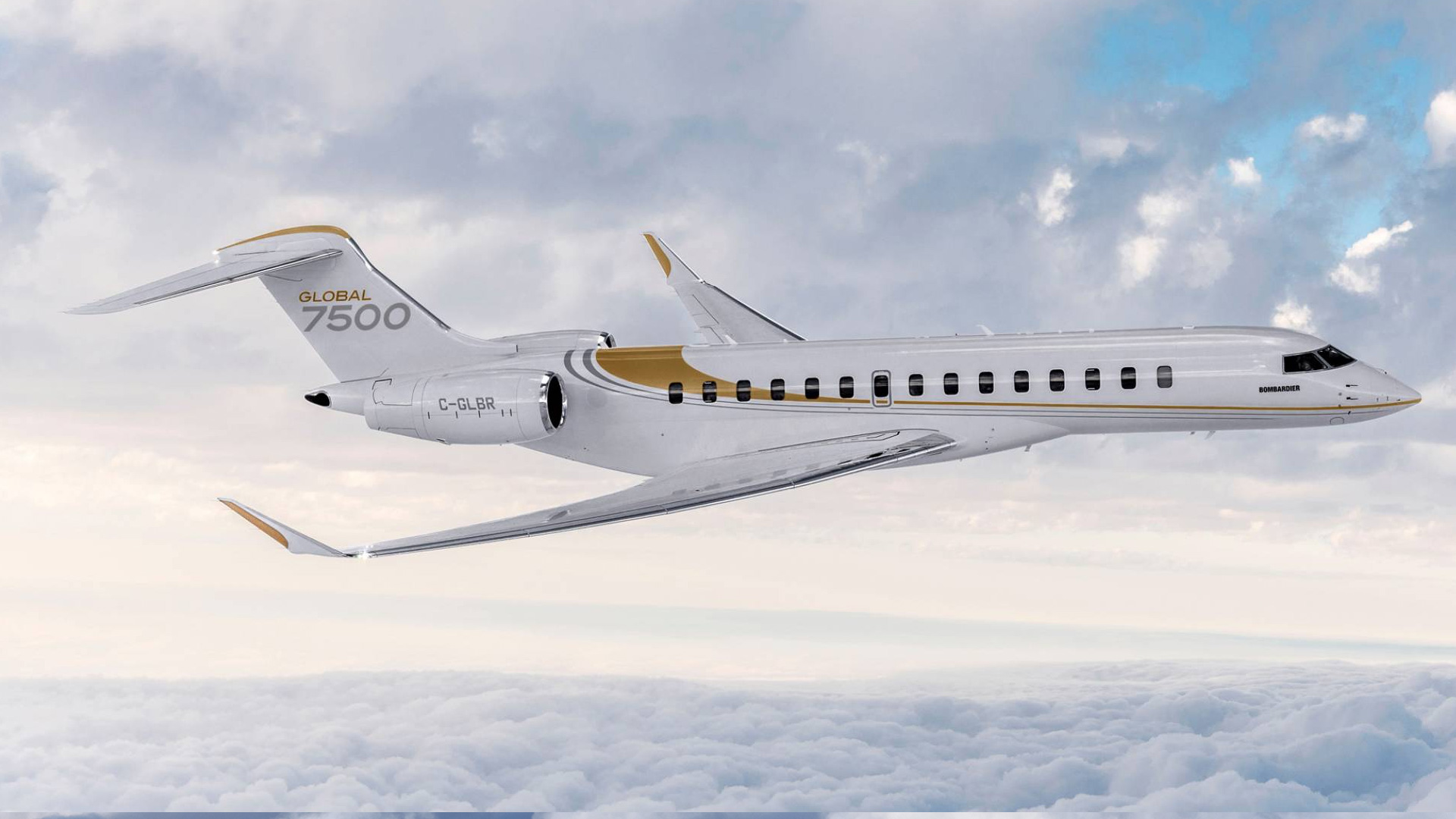
The 10 Fastest Private Jets in 2026 (Ranked)
Rankings use Maximum Operating Speed (Mmo) — the certified Mach limit the aircraft can fly at indefinitely in normal operation. This is the standard spec manufacturers publish and compare on. Long-range cruise speed, which is where aircraft actually spend most mission time, is noted separately.
| Rank | Aircraft | Max Speed | Long-range cruise | Max range | Entry into service |
|---|---|---|---|---|---|
| 1 | Bombardier Global 8000 | Mach 0.94 | Mach 0.85 | 8,000 nm | 2026 |
| 2 | Gulfstream G700 | Mach 0.935 | Mach 0.85 | 7,750 nm | 2024 |
| 3 | Gulfstream G800 | Mach 0.935 | Mach 0.85 | 8,000 nm | 2026 |
| 4 | Cessna Citation X+ | Mach 0.935 | Mach 0.86 | 3,460 nm | 2014 (out of production) |
| 5 | Bombardier Global 7500 | Mach 0.925 | Mach 0.85 | 7,700 nm | 2018 |
| 6 | Gulfstream G650ER | Mach 0.925 | Mach 0.85 | 7,500 nm | 2014 |
| 7 | Gulfstream G650 | Mach 0.925 | Mach 0.85 | 7,000 nm | 2012 |
| 8 | Gulfstream G600 | Mach 0.925 | Mach 0.85 | 6,600 nm | 2019 |
| 9 | Gulfstream G500 | Mach 0.925 | Mach 0.85 | 5,300 nm | 2018 |
| 10 | Cessna Citation X | Mach 0.92 | Mach 0.85 | 3,290 nm | 1996 (out of production) |
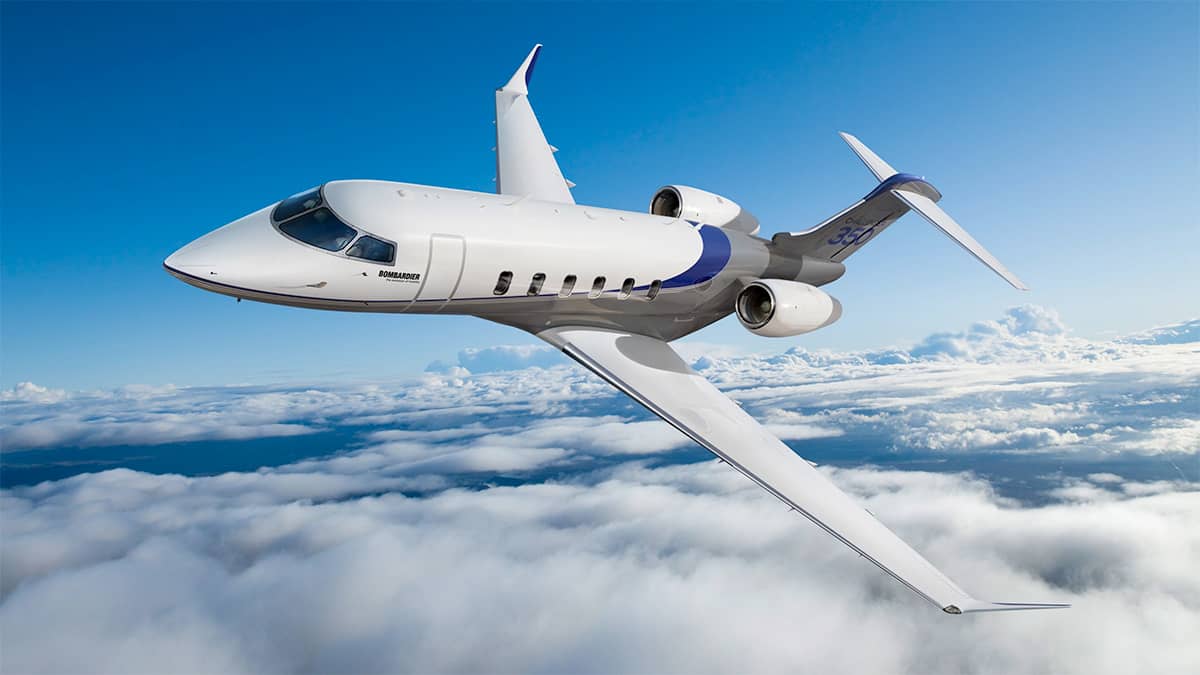
Honorable mentions just outside the top 10: Dassault Falcon 10X (Mach 0.925 planned, in development with entry in 2027), Dassault Falcon 8X (Mach 0.90), Dassault Falcon 7X (Mach 0.90), Embraer Praetor 600 (Mach 0.83 — fastest super-midsize), and the Bombardier Challenger 350 (Mach 0.83).
1. Bombardier Global 8000 — Mach 0.94
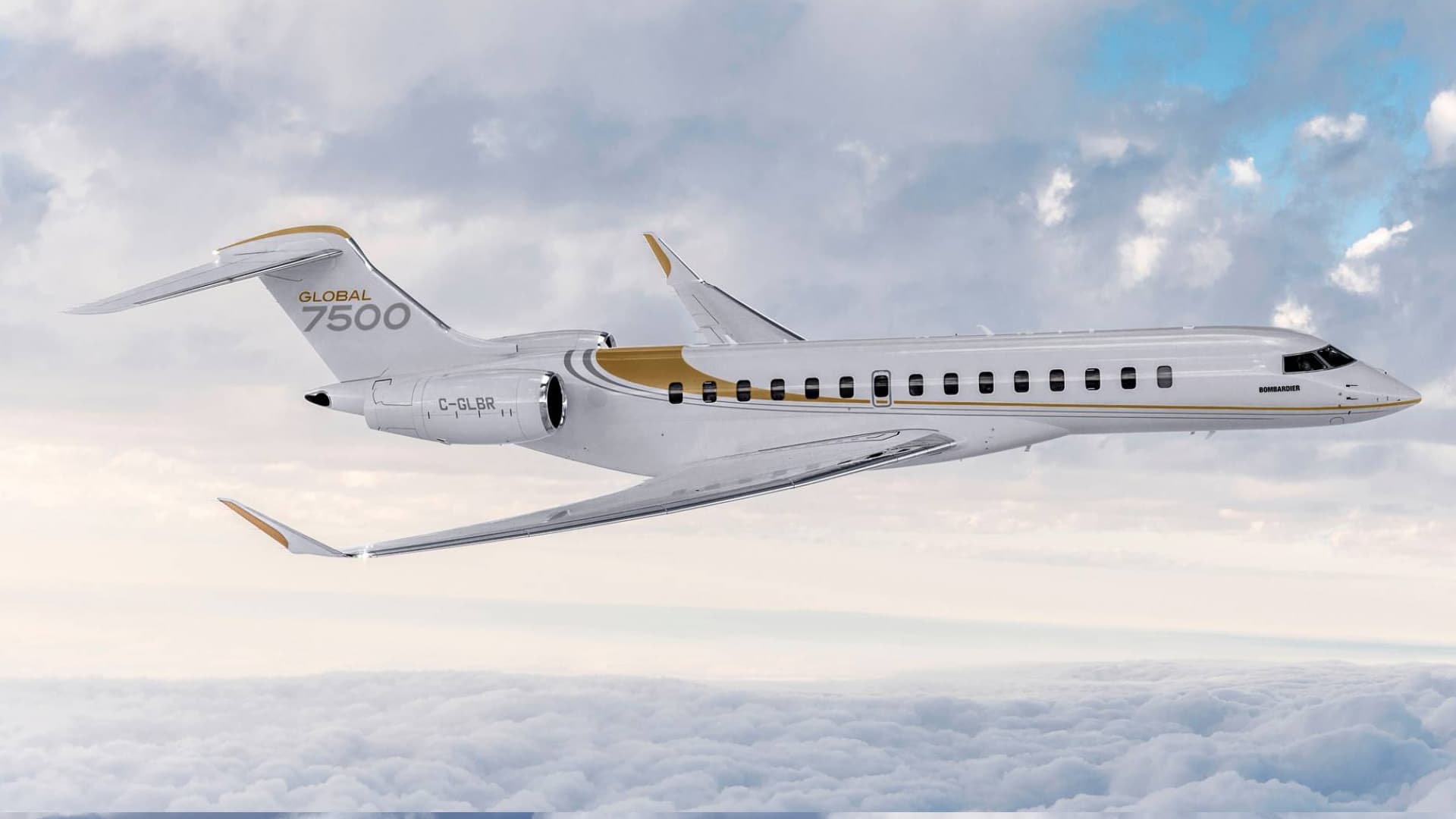
The Global 8000 took the title of world's fastest private jet in 2026, with a certified maximum operating speed of Mach 0.94 — approximately 621 knots true airspeed (715 mph). It is the derivative of the Global 7500, keeping the same airframe and four-zone cabin but adding more powerful GE Passport engines and a certified Mmo bump from Mach 0.925 to Mach 0.94. On a test flight in May 2021, a Global 7500 prototype exceeded Mach 1.015 in a controlled dive — the first business jet to break the sound barrier — in part to validate the aerodynamic envelope the Global 8000 would use. In service, the Global 8000 pairs the top speed with an 8,000 nm range, meaning it is simultaneously the fastest and the longest-range business jet in production.
2–3. Gulfstream G700 and G800 — Mach 0.935
The Gulfstream G700 (2024 service entry) and G800 (2026 service entry) share the same Rolls-Royce Pearl 700 engines and are certified at Mach 0.935 maximum operating speed. The G800 is the extended-range sibling of the G700 — same airframe cross-section, same cabin, same speed, but longer range (8,000 nm vs 7,750 nm). Both are the top-of-line Gulfstream models and compete directly with the Global 8000.
4. Cessna Citation X+ — Mach 0.935
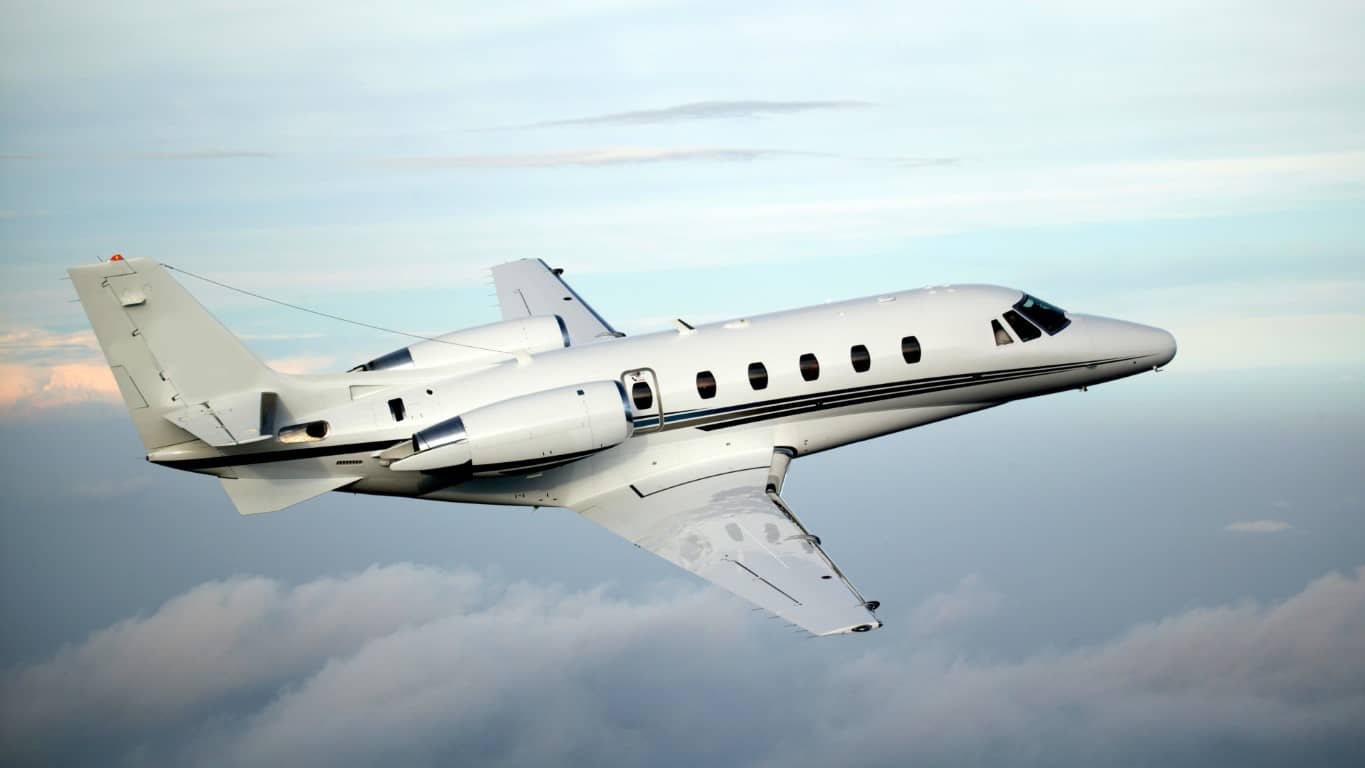
The Citation X+ held the title of "fastest civilian aircraft in the world" from 2014 until the G700 overtook it. It is a midsize jet (not an ultra-long-range), with a 3,460 nm range and a passenger-carrying speed record of Mach 0.935. The X+ is out of production (Textron ended it in 2018), but roughly 300 Citation X and X+ aircraft remain in service and are available for charter. For missions under 3,500 nm, the Citation X+ is still the fastest point-to-point private jet you can charter — a transcontinental US flight can be as little as 3h 40m, versus 4h 15m on a Global 7500.
5–9. The Gulfstream and Bombardier Mach 0.925 Cohort
The Mach 0.925 cluster — Global 7500, G650ER, G650, G600, and G500 — is the main population of fast long-range business jets in service today. Any of these aircraft fly New York to London in roughly 6h 30m and transcontinental US in about 4h 15m at high-speed cruise. The ranking between them within the Mach 0.925 band is defined entirely by range and cabin size, not speed; the Global 7500's four-zone cabin and 7,700 nm range usually makes it the preferred choice at this speed tier.
10. Cessna Citation X — Mach 0.92
The original Citation X (1996–2012) was the fastest civilian aircraft of its era, holding the record until the X+ took over. Mach 0.92 Mmo. The design philosophy — small cabin, enormous engines, raked wings — made it faster than any other business jet in its generation despite being a midsize. Approximately 300 units built. Still available on charter from several Part 135 operators, typically at a 15–25% premium over a standard midsize jet for the time savings on long legs.
How Fast Do Private Jets Fly in Real-World Operation?
Published maximum speeds are the certified Mach limit. In practice, private jets fly most of their time at long-range cruise, which is 85–90% of maximum speed, optimizing fuel burn versus block time. Typical cruise speeds by category:
- Ultra-long-range (Global 8000, G700, G800, Global 7500, G650ER) — Mach 0.85 cruise, approximately 487 knots true airspeed (560 mph) at FL410
- Heavy jets (Falcon 7X/8X, G450, G550) — Mach 0.85–0.87 cruise, approximately 500–515 knots
- Super-midsize (Challenger 350, Citation Longitude, Praetor 600) — Mach 0.80–0.83 cruise, approximately 460–475 knots
- Midsize (Citation XLS, Hawker 850XP, Learjet 60) — Mach 0.70–0.80 cruise, approximately 405–460 knots
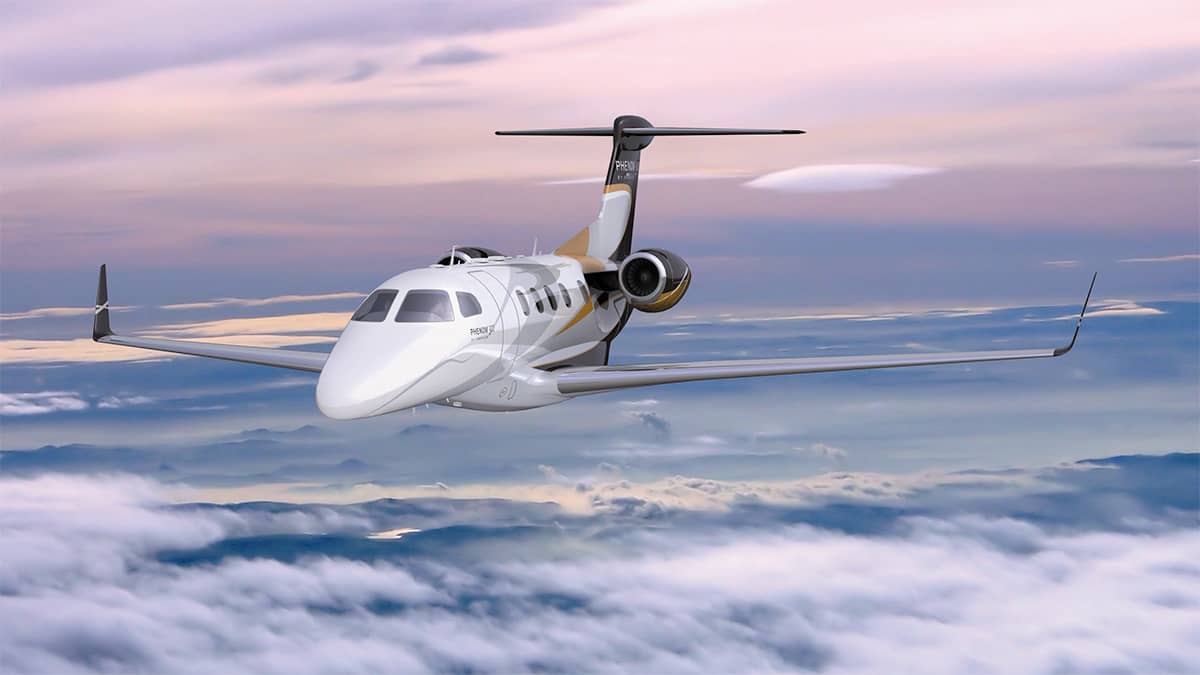
- Light jets (Phenom 300, Citation CJ3, Learjet 75) — Mach 0.76–0.80 cruise, approximately 440–460 knots
- Very light jets (Citation M2, Phenom 100, HondaJet) — Mach 0.70–0.75 cruise, approximately 400–430 knots
- Turboprops (Pilatus PC-12, King Air 350) — 275–315 knots (not jet speed)
Note that knots and mph are different units. A knot is one nautical mile per hour. To convert knots to mph, multiply by 1.15. So a jet cruising at Mach 0.85 (487 knots TAS) is flying at approximately 560 mph through the air. Over the ground, actual speed can be significantly higher (eastbound with a 150-knot tailwind over the North Atlantic jet stream, a Global 7500 can post 640+ knots ground speed) or lower (westbound into headwinds, ground speed can drop to 420 knots).
Private Jet Speed vs Commercial Airliners
Business jets are structurally faster than commercial airliners. The main reasons: higher cruise altitude (lower air density = less drag), smaller wetted surface area, and no requirement for operators to prioritize passenger fuel economy over block time.
| Aircraft category | Typical cruise speed | Max cruise | Typical cruise altitude |
|---|---|---|---|
| Fastest business jet (Global 8000) | Mach 0.85 | Mach 0.94 | FL430–510 (43,000–51,000 ft) |
| Business jet long-range cluster | Mach 0.85 | Mach 0.925 | FL410–510 |
| Boeing 787 Dreamliner | Mach 0.85 | Mach 0.90 | FL350–430 |
| Airbus A350 | Mach 0.85 | Mach 0.89 | FL350–430 |
| Boeing 777 | Mach 0.84 | Mach 0.89 | FL350–430 |
| Airbus A320 (regional) | Mach 0.78 | Mach 0.82 | FL330–390 |
| Boeing 737 MAX | Mach 0.79 | Mach 0.82 | FL330–410 |
| Concorde (retired 2003) | Mach 2.02 | Mach 2.04 | FL500–600 |
At long-range cruise, a Global 8000 and a Boeing 787 fly at essentially the same airspeed (Mach 0.85). The 787 is slightly slower overall only because the 787 captain usually chooses a slightly lower Mach for fuel economy on long-haul operations. On a point-to-point basis, the business jet almost always wins block time because it: (1) flies higher so it has fewer ATC speed restrictions, (2) climbs faster and gets to cruise sooner, (3) uses smaller airports with less taxi time and no gate wait, and (4) can descend direct rather than entering a holding pattern.
The practical difference on a transatlantic mission: a Global 7500 flies New York to London in about 6h 30m block-to-block; a Boeing 787 on the same route is about 7h 15m block-to-block and adds 45 minutes to 2 hours of gate and taxi overhead on each end.
Why Business Jets Fly Faster Than Airliners
Three structural reasons:
- Higher operating altitudes. Modern business jets routinely cruise at FL450–510 (45,000–51,000 ft). Airliners cruise at FL330–430. At FL510 the air is roughly 20% thinner than at FL390, so a given thrust pushes you faster through less drag.
- Smaller wetted area per passenger. A Global 7500 has about 2,500 ft² of total wetted (exposed to airflow) surface and 14–19 passengers. A Boeing 787 has about 20,000 ft² and 240+ passengers. Business jets have more thrust-to-drag headroom per passenger-mile.
- Engine design priorities. Business-jet engines like the Rolls-Royce Pearl, GE Passport, and Honeywell HTF7000 are optimized for high-altitude cruise efficiency and quick climb rather than for the maximum-economy very-high-bypass turbofans airlines use. The GE Passport on the Global 7500/8000 can deliver its best SFC above FL430, where airliners rarely fly.
The ceiling on business jet speed is primarily the "sound barrier" at Mach 1.0 — transonic drag rise above Mach 0.95 makes going faster uneconomical even if the airframe can handle it. All current fastest business jets cluster at Mach 0.90–0.94 because that is the practical top end before fuel burn rises exponentially. Bombardier's May 2021 Global 7500 supersonic test flight (Mach 1.015 in a dive) was a demonstration of airframe capability, not a sustainable cruise condition.
Charter Cost of the Fastest Private Jets
Speed and cost are correlated — the fastest aircraft are also the most expensive to charter, because the top-speed category is also the ultra-long-range category where the aircraft themselves cost $70–$80 million new.
| Aircraft | Max Speed | 2026 Charter rate | New York → London (typical cost) |
|---|---|---|---|
| Bombardier Global 8000 | Mach 0.94 | $14,000 – $24,000/hr | $120,000 – $160,000 |
| Gulfstream G700 | Mach 0.935 | $13,000 – $22,000/hr | $110,000 – $150,000 |
| Gulfstream G800 | Mach 0.935 | $13,500 – $23,000/hr | $115,000 – $155,000 |
| Cessna Citation X+ | Mach 0.935 | $6,500 – $11,000/hr | n/a (range-limited) |
| Bombardier Global 7500 | Mach 0.925 | $12,319 – $23,400/hr | $110,000 – $145,000 |
| Gulfstream G650ER | Mach 0.925 | $11,500 – $19,500/hr | $100,000 – $135,000 |
| Gulfstream G650 | Mach 0.925 | $11,000 – $18,500/hr | $95,000 – $130,000 |
| Gulfstream G600 | Mach 0.925 | $9,500 – $15,000/hr | $80,000 – $110,000 |
| Gulfstream G500 | Mach 0.925 | $8,500 – $14,000/hr | $75,000 – $100,000 |
| Cessna Citation X | Mach 0.92 | $5,500 – $9,500/hr | n/a (range-limited) |
The Citation X and X+ stand out as the "value speed" picks. They cannot cross the Atlantic non-stop (3,290–3,460 nm range), but on transcontinental US and intra-European missions they deliver Mach 0.92+ speed at a charter rate half the ultra-long-range category.
Frequently Asked Questions
What is the fastest private jet in the world?
The fastest private jet in the world in 2026 is the Bombardier Global 8000, with a certified maximum operating speed of Mach 0.94 (approximately 621 knots true airspeed, 715 mph). It entered service in 2026 and took the top spot from the Cessna Citation X+ (Mach 0.935), which had held the title since 2014. The Gulfstream G700 and G800 are the current closest competitors at Mach 0.935.
How fast does a private jet fly?
Most private jets cruise between Mach 0.75 and Mach 0.85 (roughly 440–490 knots or 505–565 mph) at altitudes of 41,000–51,000 feet. Top speed depends on category: light jets like the Phenom 300 cruise at Mach 0.78 (~450 knots); midsize jets like the Citation XLS at Mach 0.75; super-midsize at Mach 0.80–0.83; and ultra-long-range aircraft like the Global 8000 cruise at Mach 0.85 and can reach Mach 0.94 at maximum speed.
How fast is a jet in mph?
Most business jets cruise at 500–560 mph. The fastest private jet in 2026, the Global 8000, has a top speed of approximately 715 mph (Mach 0.94). Commercial airliners typically cruise at 540–580 mph. The retired Concorde cruised at approximately 1,350 mph (Mach 2.02), more than twice the speed of modern business jets.
How fast does a jet plane go?
Jet speed depends on the type of aircraft. Modern civilian jets (both business and commercial) cruise at 500–580 mph. Military jets like the F-15 can reach Mach 2.5+ (approximately 1,900 mph). Experimental aircraft and supersonic business jets in development (Boom Overture) target Mach 1.7 (~1,300 mph), targeting entry into service in the early 2030s. The fastest current business jet, the Global 8000, flies at approximately 715 mph top speed.
How fast do private jets fly compared to commercial airliners?
Private jets are structurally faster than most commercial airliners at the top end. The fastest business jet (Global 8000, Mach 0.94) outruns a Boeing 787 (Mach 0.90) or Airbus A350 (Mach 0.89) and comfortably exceeds a Boeing 737 or Airbus A320 (Mach 0.78–0.82). At typical long-range cruise, both business jets and modern wide-body airliners fly at about Mach 0.85, with the business jet winning on block time due to higher operating altitudes, less congested airports, and no gate wait.
How fast is a jet in kph (km/h)?
Private jet cruise speed in kilometers per hour: light jets cruise around 800–830 kph, midsize jets around 780–850 kph, super-midsize around 850–880 kph, and ultra-long-range at approximately 900 kph (560 mph) cruise and 1,150 kph (715 mph) top speed on a Global 8000.
Why do private jets fly faster than airliners?
Three main reasons: business jets cruise at higher altitudes (45,000–51,000 ft vs 33,000–43,000 ft for airliners) where thinner air allows faster speeds at the same thrust; business jets have smaller wetted surface area per passenger, giving them more thrust-to-drag headroom; and business-jet engines are optimized for high-altitude cruise efficiency rather than the maximum-economy very-high-bypass turbofans airlines use. These structural advantages give business jets 10–50 knots of additional cruise speed on comparable routes.
What's the fastest route I can fly on a private jet?
The fastest point-to-point private jet mission in 2026 is New York to Los Angeles on a Citation X+ at Mach 0.935 cruise — about 3h 40m eastbound and 4h 00m westbound block time. For transoceanic missions, the Global 8000, Gulfstream G700, and G800 all cross the Atlantic in approximately 6h 15m–6h 30m from the US East Coast to London. For a London to Hong Kong mission, the Global 8000 posts the fastest non-stop time at approximately 11h 45m.
Can a private jet fly supersonic?
No current production business jet is certified for sustained supersonic cruise. A Bombardier Global 7500 briefly exceeded Mach 1.015 in a controlled dive during a May 2021 test flight — the first business jet to break the sound barrier — but this was an aerodynamic validation, not a sustainable cruise condition. Supersonic business jets are in development: Boom Overture targets Mach 1.7 commercial operation starting early 2030s. For now, the fastest civilian aircraft all cruise subsonic at Mach 0.85–0.94.
How much does it cost to charter the fastest private jet?
Charter rates for the fastest private jets in 2026: Bombardier Global 8000 at $14,000–$24,000 per flight hour; Gulfstream G700 at $13,000–$22,000/hr; Gulfstream G800 at $13,500–$23,000/hr; Citation X+ at $6,500–$11,000/hr. A typical New York to London mission on a Global 8000 or G700 costs $110,000–$160,000 one way. The Citation X and X+ offer the "value speed" option — Mach 0.92+ cruise at a charter rate roughly half that of the ultra-long-range cohort, with the tradeoff of range limited to about 3,500 nm.
Book the Fastest Private Jet for Your Mission
Speed is one of the three factors that matter in choosing a charter aircraft — the other two are range and cabin space. For missions where speed is the deciding factor (urgent transcontinental, time-sensitive transatlantic, VIP shuttle between major cities), the Mach 0.90+ cohort of ultra-long-range Gulfstream and Bombardier aircraft plus the Citation X+ are the right choices. For most other missions, a slower super-midsize or midsize jet delivers 90–95% of the block time at 40–60% of the charter cost. For a live quote on any aircraft in the top-10 fastest list — or current empty leg opportunities on these aircraft — request a quote from DesJets. See also our 2026 guides on the Global 7500, Challenger 350, Phenom 300, and Citation XLS, and our full breakdown of private jet charter costs across every category.